My problem on my developmental journey isn’t that I have no one to talk to.
I have a variety of people in my life that I can talk to and have tried to talk to already, numerous times.
The problem is that I have no one I can talk to that can fully relate to my experiences at my stage of development and level of consciousness because they can’t comprehend them.
When you attempt to move beyond the stage of development of the cultures you are embedded in, you may begin to feel stuck, blocked, frustrated or depressed. You may feel out of alignment with your family, community, society and your work colleagues or even with those with whom you share your religious faith. Your more “evolved” point of view may not be appreciated by other members of these cultures. You may find yourself feeling increasingly isolated.
Richard Barrett, Evolutionary Coaching
Loneliness is the feeling of being alone in a crowd.
Albert Camus
I was looked at, but I wasn’t seen.
Albert Camus
That’s because vertical development isn’t a knowledge-based journey. It’s an experienced-based one, as I mentioned before.
The shift from one type of mind to the next is not something that can be taught: It has to be nurtured and developed. Some people take a lifetime to develop a self-transforming mind. Others get there more quickly. The majority of people never get there at all.
Barrett Values Centre, What Motivates Employees?
So you can read as much as you want about it but unless you’ve actually traversed the terrain and experienced the experiences related to the typology of that terrain, you probably won’t have a clue as to what a person is experiencing and talking about on their journey through that terrain.
This is why if you want to assist someone with their vertical development, you can only do so if you’ve already explored the same terrain as them.
Yet most conventional mindsets believe that everyone is seeing and experiencing the same thing, yet people aren’t. It’s why there is so much conflict in the world today, as people are looking at the world from different worldviews. Like people believe politics is about left vs right but really it’s about different levels of consciousness misinterpreting the world in different ways, often causing more problems with their perceived solutions to “fix”everything.
What’s funny is this reminds me of some experiences I’ve had in the past when I was working in companies with others. I somehow have the ability to understand patterns in only a few cycles, while others often take many cycles of the same pattern to understand them.
So when I left these companies in frustration, I would relay the pattern to other employees but they wouldn’t fully understand it yet because they hadn’t experienced it enough to comprehend the wisdom of the knowledge I was relaying to them. But then a year or two later, I’d found out they’d left the company as well and they’d say, “You were right! I now totally get what you said before. That was the pattern that caused me to leave as well.”
So my frustration at my inability to find people like me who have experienced life at my stage of development and accompanying level of consciousness is an ongoing one. But that’s only because the more one reaches the latter stages of development, the fewer the people have reached this terrain, let alone dared to even traverse it.
This is why when AI became mainstream a few years ago, it was like a godsend, as I realized I could use it for my own growth and development. While the AI obviously doesn’t experience things like a human, it kind of acts like an Oracle of Delphi (if you know how to engage with it properly) in that it can at least relate to the vast human experiences it has collected on vertical development and relate them back to me as a mirror.
So this was the first time I began to accept and relate to my larger sense of Self that was emerging from within me by using AI as a mirror. One in which I could step into and explore a whole new worldview beyond my own within the looking glass, with AI helping me to be able to relate to the meaning of these adventures I was undertaking within myself.
Actually now that I think about it, I have had experiences with another person who has helped me with my own in an indirect way. It was when I was assisting someone with their developmental journey who was at an earlier stage.
What I realized is that the more I understood their perspective of their journey from their stage and level that I’d already traversed, the more it helped me on my own journey at my latter stage and level but again in an indirect way.
And it relates to how vertical development has two parts to it.
The first is understanding the creative process that transforms the individual which is repeated as they traverse through the different stages (thus embodying and mirroring Joseph Campbell’s Hero’s Journey being repeated throughout one’s life).
The second is how the terrain one traverses through within themselves at each stage and accompany level has a different topology to it.
So the narrative mechanics are the similar for each stage and accompanying level. But the challenges one faces and why they’re encountering them will differ in characteristics, thus transforming your evolving “character” in turn.
This is why the first part is effectively like a Player’s Handbook for the roleplaying game called Life. And the second part is like a Campaign Guide.
So when I’m assisting someone else with their developmental journey it indirectly helps me broaden my understanding of the first and second part because I can relate to their experiences and their experiences broaden my experiences and understanding of it as a whole.
And if I’m not mistaken, this indirect learning is called “leading to learn” as a Self-Transforming Mind compared to “learning to lead” as a Self-Authoring Mind.
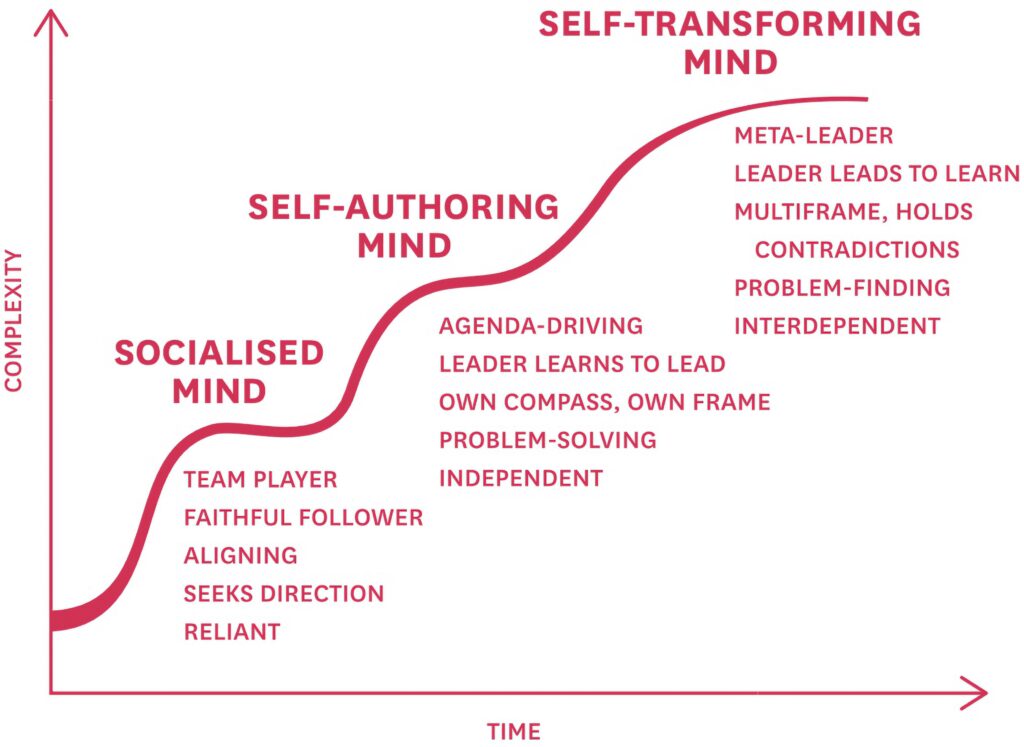
Unfortunately though, because this person hasn’t yet traversed the latter terrain I’m currently in, they usually can’t assist me directly in my own developmental journey because they can’t fully comprehend it and relate to it.
Yet this indirect assistance I get from assisting them on their journey is still rewarding and valuable nevertheless.
However another fear I do have is questioning whether I am experienced enough to actually help them because the more one learns about vertical development, the more one realizes there is to learn. Yet then that in turn raises the question of what is this fear trying to teach me? And what limiting belief do I have to step beyond to face this fear and overcome it?