Categories
Life's a Role-Playing Game

Embracing the Certainty of Uncertainty

How to become an adventurer of life.

People often say there’s no end to growth because you never arrive at absolute certainty.

But what if the very thing you’re struggling with—your need for certainty—isn’t the obstacle at all, but the pressure that pushes you to grow?

Certainty begins as something essential. It stabilizes you, gives you direction, and helps you make sense of the world.

Eventually, that same certainty becomes too narrow to contain the complexity of the life you’re living.

That tension is the constraint.

And that’s where development happens. The pressure isn’t telling you to abandon certainty—it’s exposing the limits of the kind of certainty you’ve been relying on.

You leverage the constraint by letting the meaning of certainty shift from something you get from the outside—fixed beliefs, fixed identities, fixed maps—to something that comes from the inside: your ability to stay grounded, adaptive, and present even when things change.

That’s how certainty appears within uncertainty: not as knowing what will happen, but as knowing you can respond to whatever arises.

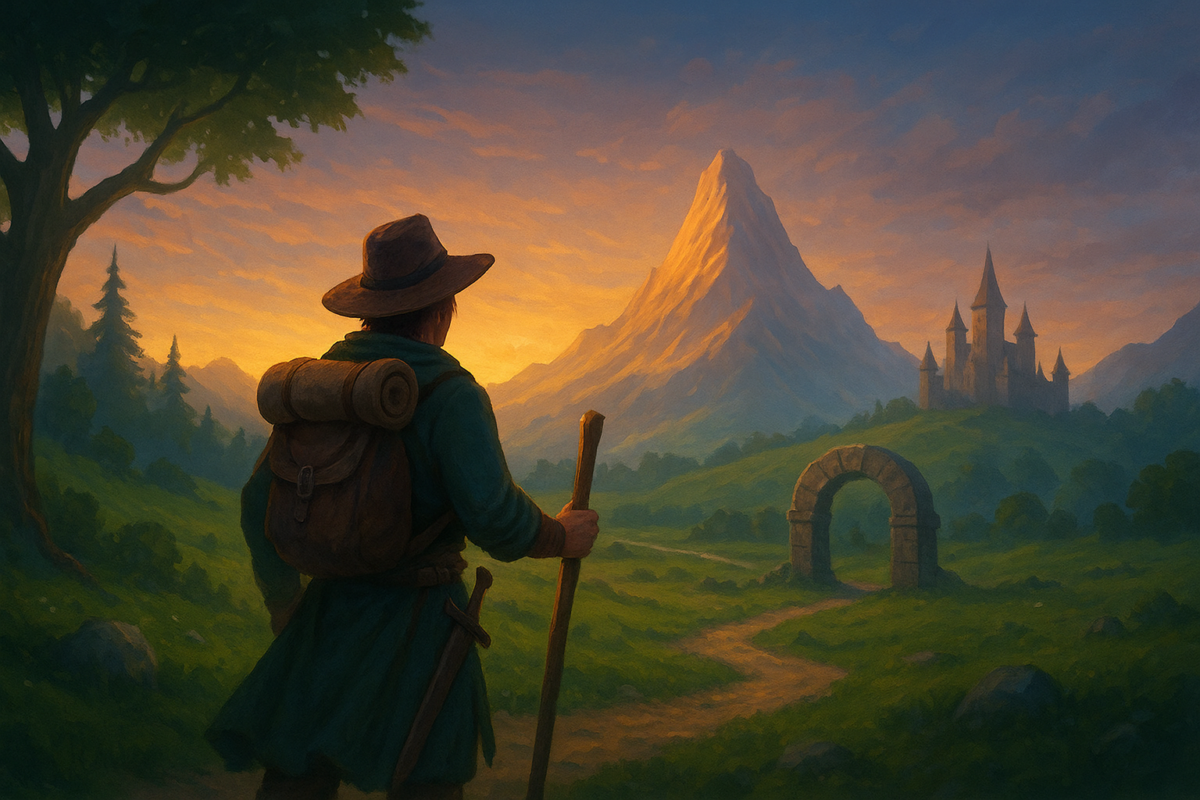
This what it means to be an adventurer of life.

And this is what the adventure of your life is all about.

A true adventurer:

  • Doesn’t rely on stable terrain.
  • Doesn’t rely on a stable self-image.
  • Doesn’t even rely on a stable sense of “capacity.”
  • Does rely on something more fluid: ongoing responsiveness.

They move because movement itself is the grounding.

So the adventurer isn’t someone who has figured out the map; they’ve stopped relying on one entirely. Navigating without fixed bearings, they move with ease and curiosity. The ‘not knowing’ isn’t fear—it’s openness; the ‘not lost’ isn’t certainty—it’s a felt trustin responding to whatever arises.

Lost? No.
I don’t know where I am,
but I’m not lost.

Emile Khadaji, The Man Who Never Missed

This reframes growth entirely: it isn’t about acquiring skills or knowledge to reach a fixed endpoint, but about cultivating the capacity to exist and act within the unknown. Certainty isn’t the goal—it is surrendered. In its place emerges a dynamic, lived awareness that allows the adventurer to navigate life’s hidden levels without being confined by the need for fixed answers.

This is the paradox at the heart of it. In the latter stages of life, the adventurer has “reached the end” not by arriving somewhere, but by fully embracing the fact that there is no final destination. They are no longer chasing certainty or completion; they are oriented in the process itself.

It’s a kind of mastery that isn’t mastery of outcomes—it’s mastery of presence, responsiveness, and engagement. They move through life knowing that every ending is provisional, every answer temporary, yet they are fully anchored in the act of navigating, of participating, of being alive in the unknown.

So one realizes that the journey is never-ending, but the sense of arrival comes from shifting the lens. Arrival isn’t about reaching a fixed point; it’s the experiential recognition that you are already where you need to be in the midst of the journey.

This is how one can be certain in the face of life’s uncertainty.

So your certainty isn’t about fixed outcomes, rules, or destinations—it’s a certainty of orientation. You’ve experienced the process of letting go of the need for certainty, and that lived understanding gives you confidence in the perspective itself.

It’s a meta-certainty: you know how uncertainty functions as the engine of growth, how surrendering the old anchors reveals a deeper, flexible grounding. You can speak with assurance about this perspective because it isn’t an abstract idea—it’s something you’ve embodied through experience.

Do you see the elegance of this paradox?

You become certain about uncertainty, confident without clinging, anchored without relying on fixed points.

That’s the signature of the adventurer mindset: you move through life grounded, not in fixed answers or maps, but in the embodied trust that you can navigate whatever emerges.

It’s paradoxical but precise—certainty isn’t about controlling the world; it’s about knowing you can respond to it.

And this is where life becomes a game—not in the sense of triviality, but in the deepest, most transformative sense. Just like in an MMORPG, the adventurer isn’t afraid to explore the unknown because the unknown is where growth, discovery, and wonder happen. Every challenge, every uncharted path, every encounter is part of the unfolding story.

Play, at this level, isn’t escape. It’s the art of engaging fully with the unknown, of experimenting, testing, learning, and responding—all while remaining fully present. Life itself becomes the adventure, and the adventurer moves not out of obligation or fear, but out of curiosity, joy, and the thrill of discovery.

This is why people are drawn to games like World of Warcraft or other MMORPGs: they offer a safe space to practice navigating uncertainty, to explore new terrains, to take risks and fail, to recover, and to grow—all in a way that feels alive, meaningful, and playful. The same principles apply to life: by embracing uncertainty and letting go of the need for fixed outcomes, we unlock the possibility of living fully, creatively, and adventurously.

In this way, life is the ultimate, epic role-playing game—and you are both player and terrain, explorer and map, navigating the endless quest of your own becoming.

Categories
General

Standing on the Edge of a Cliff of Embodiment

Something feels wrong.

I think what I’m being asked to do by life is to completely let go of my “self” and embody something larger than myself. So it’s about completely letting go of the usual role I play (and currently feel stuck within), that being just trying to explainthings to others which requires a massive amount of scaffolded knowledge to do so.

Instead I’m effectively being asked to jump off a cliff of embodiment and trust that life will guide and carry me, expressing something through me. 

The best way I could explain this is using a quote from the trailer for the Amazon Prime Secret Level tv series…

How many lives would you give…

…just to discover what you’re capable of?

…which mirrors this other quote by a notable author.

You have to die a few times before you can really live.

Charles Bukowski

And it also mirrors something I said a long time ago. 

I’m dying to feel alive.

Categories
General

Shifting Your Point of Vantage

BTW if it’s not already apparent, I don’t have this all figured out.

It’s just that my perspective and relationship to that statement—what it means—is radically different than the conventional perspective of it.

That’s how growth and development transforms you. It changes how you relate to things.

Before you might have see something as “wrong” or “bad” and suddenly a perspective shift causes you to see it as “right” or “good” because you’re perceiving the context of it within a completely new way from a completely new point of vantage.

This is why if I had believed I had everything figured out, life wouldn’t be very exciting and adventurous (although my ego would be happy as a know-it-all). It’s only because I don’t have everything figured out and I don’t know everything, that the unknown and ambiguous nature of life holds so many possibilities and potential for me to explore—a true adventure.

Categories
General

Writing From the Outside Inwards

Something just clicked in a conversation with ChatGPT as to how I can make my work more relatable and understandable without losing the collection of metaphors that form an allegory to describe it all.

Normally I write post titles from a perspective of “within” the allegory. Of course in doing so, readers don’t relate to it because they aren’t “within” it yet but are looking at it from the “outside.”

So the idea is to flip my whole approach around. My post titles and the opening of my posts will focus on where people are at from the “outside” and then I’ll lead them “inside” the allegory by the end of the post.

For example, I was going to write a post which I was going to title “The Great Wilderness” which won’t make sense to anyone. Instead I’ll title it “Why You Can’t Find Solid Ground Anymore (and Why That Might Be a Good Thing)” which hopefully relates more to where people are at.

However in terms of tag use for content organization to organize posts, I will use these metaphors to show the allegory outline as a whole which will allow people to see how the non-metaphor post titles will relate to the metaphor and larger allegory as a whole.

Categories
General

Disrupting Others by Disrupting Yourself

People at the earlier stages of development usually want things to stay the same. So they don’t want people to change, as change feels risky because it can shake the sense of who they are and where they belong.

People in the middle stages start to see new possibilities and often want to help others change and thrive too…but usually in the direction they think is best.

People at the latter stages stop trying to fix or convince others. They paradoxically just focus on growing and being real themselves, knowing that kind of honesty naturally encourages others to grow too.

“Knowing” this is easy. Embodying it is epically challenging.

Categories
General

How to Trust the “Player” Guiding Your “Character”

To visualize this stepping out of one’s “self” to create a sense of psychological distancing, imagine you’re playing a MMORPG game like World of Warcraft as a “player character.”

Your “character” is who you believe you are, your identity / ego as a construct, because you’re so immersed within the game.

You as a “player” represent the boundless you, your soul.

So being able to step out of both your present “self” and future Self is like a liminal moment of being boundless and witnessing yourself outside of time and space. It’s a moment where you become aware that you are not a body with a soul but rather a soul with a body.

So this process is one in which you let go and follow the lead of your larger sense of Self trying to emerge from within the hidden depths and core of yourself.

Categories
General

“Hold the Door!” Hold It Open!

My work seems to be about experiencing ontological dissonance within one’s life which arises from a collection of cognitive dissonance forming a door or portal that can allow one to teleport to a new sense of being.

This portal, however, seems both foreign and dangerous, yet alluring and mysterious at the same time.

The trick with it is to not close the portal prematurely, assuming we “know” what it is and means, but to continually hold space for it, so you can explore the emerging meaning of it daily, like an adventurer making forays and dispatches from a new world which embodies a newer, larger sense of Self.

Artwork by Matt Rockefeller
Categories
General

Me, Myself, and I Am

I once told someone who was struggling through a growth moment, beating themselves up in the process, that there is more potentiality within them than they’re aware of and realize.

I indicated that when they feel compassionate and try to help someone else, think of themselves as that person and apply what they said to them to their very self.

This is not always easy to do though because 1) you need to be able to step outside of your current “self” and 2) perceive yourself as both your future Self helping your present “self” which 3) means being neither of them and both of them at the same time.

Categories
General

From Expertise to Emergence

Why the future of sharing isn’t about what you know but how you make sense and meaning of change as a challenge to your life.

I just had a realization based upon what I’ve been seeing happening online on platforms like Substack.

The old “expert model” of social media was built on stability, where you mastered a topic, established credibility, and then broadcast your expertise outward. It assumed a relatively stable world where knowledge had lasting value.

Then came “learning in public” which was a response to accelerating change. The idea was that transparency and curiosity mattered more than authority. Yet even that model assumed a kind of linearity: you’re on a knowable path of learning something specific, and the social experience is about documenting that path as it unfolds.

But in today’s world, change is not just faster, it’s nonlinear and emergent. What we’re dealing with isn’t just learning new information but learning how to learn in the midst of instability. So the social experience that fits this era might not be “sharing expertise” or “sharing learning,” but something like “sharing emergence” which is about being in visible dialogue with uncertainty itself.

That would mean showing how sense-making and meaning-making happen before learning stabilizes, so when it’s still messy, ambiguous, even contradictory. It’s not about “Here’s what I know” or “Here’s what I’m learning,” but rather “Here’s what’s trying to form through me in real time, even though I don’t yet know what it means.”

That kind of presence fits a world where transformation, not transmission, is the real work.

And this type of presence is what I continually struggle to outwardly express as my mantra of “the adventure of your life,” even though it is a daily inner experience for me.

In closing, I just want to highlight one of the best examples I’ve seen so far that actually embodies this sharing of emergence. It feels a bit messy and chaotic, yet at the same time it’s real and authentic, as though the person is stumbling through a wilderness, trying to make sense of their inner terrain in the present moment.

Years of Destroying What Actually Works by Brad Did

Categories
General

Playing

Making life a meaningful adventure of growth and self-discovery.

Work, work, work, work, work.

For many people, this is what their entire lives revolve around. Working. So much so that they have very little time to actually live.

However, for more progressive individuals and organizations today, life-longing learning is becoming just as important as work, especially in relation to the future of work that’s emerging right now.

Because of this, what appears to be happening is that no longer does learning just happen in the early stages of our lives but it’s becoming a life-long, daily endeavour.

But what about playing though?

If learning is becoming a daily endeavour, just as much as working, what about playing?

Perhaps it depends upon what we mean by playing?

If we perceive playing as some frivolous, childish activity that is often a waste of time than, more often than not, playing obviously won’t be a part of the future of work.

However, if we perceive playing as something much more substantial than the conventional aspect of it, perhaps it can be something integral to our daily lives, just as much as working and learning can be.

To begin to transform our understanding and perception of playing, let’s get Stuart Brown to help us by referring to some of his quotes from his book Play: How It Shapes the Brain, Opens the Imagination, and Invigorates the Soul.

I have found that remembering what play is all about and making it part of our daily lives are probably the most important factors in being a fulfilled human being. The ability to play is critical not only to being happy, but also to sustaining social relationships and being a creative, innovative person.

Once people understand what play does for them, they can learn to bring a sense of excitement and adventure back to their lives, make work an extension of their play lives, and engage fully with the world.

Ultimately, this book is about understanding the role of play and using it to find and express our own core truths. It is about learning to harness a force that has been built into us through millions of years of evolution, a force that allows us to both discover our most essential selves and enlarge our world. We are designed to find fulfillment and creative growth through play.

The genius of play is that, in playing, we create imaginative new cognitive combinations. And in creating those novel combinations, we find what works.

The truth is that play seems to be one of the most advanced methods nature has invented to allow a complex brain to create itself.

Of all animal species, humans are the biggest players of all. We are built to play and built through play. When we play, we are engaged in the purest expression of our humanity, the truest expression of our individuality. Is it any wonder that often the times we feel most alive, those that make up our best memories, are moments of play?

Stepping out of a normal routine, finding novelty, being open to serendipity, enjoying the unexpected, embracing a little risk, and finding pleasure in the heightened vividness of life. These are all qualities of a state of play.

To sum up with Stuart Brown is saying here, play isn’t just a pastime—it’s a natural drive and orientation to life that sparks creativity, reveals our true selves, deepens connection, and turns everyday life into a joyful adventure.

To take this a step further though, in terms of understanding how play specifically is integral to our development and “levelling up” in life, not just as children but as adults as well, let’s get D. Stephenson Bond to help us by referring to some of the quotes from his book Living Myth: Personal Meaning as a Way of Life.

I want to suggest for now that play is our participation in the process of our own development through the imagination. Adults mature through play just as children mature through play precisely insofar as play represents the intermediate step from potential development to actual “work.”

There is a movement beyond conscious play. We all have private fantasies. We all have guiding fictions of our life in our “personal intermediate areas,” that we may or may not share with others whom we trust. But there comes a time when we must make a claim, when simple insight seeks a lifestyle; a time when we’ve played long enough with what may or may not be, and in that day simple play becomes a game with rules for living meaningfully.

There must be a middle ground, a place between two worlds. There must be a place where inner life can find the validation to hold itself together. At the same time there must be a place where outer life can open itself to imagination rich enough to offer meaning. There must be an “intermediate area of experience,” as Winnicott said, where what is subjectively conceived of meets what is objectively given—in other words, a place to play in trust so strong it becomes a way of life.

What is risked in play is the sense of self. Therefore, the building of the symbolic field has to do with the building of trust in the sense of self that is risked in play.

After the field is prepared, at a certain point in this creative process a person is ready to play. A moment comes when there is simply no other choice. We have to liberate ourselves from the idea that playing is for children. Playing, as we shall see, is for maturation. In that sense, as Jung said, play becomes serious.

And then comes immersion, the moment of being lost in play. This is the transitional state, a different state of consciousness. The potential space “is akin to the preoccupation that characterizes the playing of a young child.” Immersion is an in-between state. “This area of playing is not inner psychic reality….It it outside the individual, but it is not the external world.” Immersion is the sense of fantasy activity becoming “real.” Then the writer feels the story writing itself and hours are lost.

What emerges in play is crucial. Three remarkable things occur in play: something emerges from within (potential); something emerges at the right time (developmental work); something is formed (a sense of self).

The phenomenon of imagination has to do with the emergence of a content from what in potential is only form. The virtual miracle of the creative act is through the crystallization of what is needed but not known—a pattern inherent in the situation. Play is an event, a true gestalt—something potential evolves into something actual. Through playing the pattern is recognizedAnd we’ve stumbled on quite a different way of knowing. Potential, hidden in the unconscious matrix, is “known” through play that gives it substance.

The subtle aspect of potential forms and possibilities is that the moment they are actualized, they cease to be potential at all. The actualization never really fullyincarnates the potential. Therefore, what actualizes is the resonance. What emerges is a metaphor, which connects the potential with the actual. Metaphor is play.

It is the yearning for development, for evolution. What emerges in play wants to go somewhere. Play becomes developmental work.

Maturation, fully living the pattern of development, leads to a growing sense of self. The play on the symbolic field must eventually lead to something durable and vital. Play aims at coalescing into a work, an “opus.” The structure that emerges in play is the sense of our self as a “self.” If I may suggest this subtle distinction: play, if followed to its true development, evolves into a game. In the end play imposes a set of rules. It begins to develop into a way of life, which is to say, a myth.

In play we come to experience our whole self through relationship.

We learn to “play” in a serious way that produces something vital and durable. As a result, we are left with a “felt sense of meaning.” The relationship to the psyche matures into a new context. Play becomes a game. Personal meaning becomes a way of life.

The personal myth is the meaning that spans the gap between outer and inner life. It restores the context through which the two are related. Myth is the age-old image for the perception of integration—how the larger world and my life fit together; a pattern in which my life finds its relationship to all its parts. That’s what “meaning” feels like—you know how life fits. Once the meaning is perceived, then each of the separate parts begins to fit together. Each part the myth touches feels alive—multidimensional and multilayered. Soulful imagination begins to penetrate each separate moment. You discover the symbolic life. Outer life feels layered with inner meaning; inner life pushes for outer manifestation.

And that is so because in times like these many people desperately seek a context in which to play. All too often, we are watching other people play. We are literally paying people millions of dollars to play for us. And not just on the baseball diamond. They are playing for us on compact disks; playing for us on videotape; playing for us on the stage, at the concert, on the silver screen. We pay them because they play so well. But perhaps we pay them in exact proportion to our longing to be playing ourselves, which is why they are worth more and more every year. The longing for play is the longing to take the field ourselves, to play with heart and soul as each of us has the potential. We need a lifestyle that creates a context for us to make our own music, rather than always listen; do our own dancing, rather than always watch; perform our own plays, make our own films, write our own stories.

To sum up what Bond is saying here, it’s that play is the serious work of becoming, where imagination shapes our potential into a larger, meaningful sense of Self that emerges from a nurturing and supportive liminal space of being within ourselves.

And if we perceive playing in this larger, more meaningful way than it becomes something integral to our daily lives, just as much as working and learning are. Even more so because of our rapidly changing world around us.

Finally, if it’s not already apparent from reading the quotes above, my own life’s work that I’m sharing here emerged and is still emerging in very much the same way. It is emerging from a lifetime of experiences and knowledge that are integrating together and birthing through playful imagination. And my struggle to articulate it here is part of the process, of figuring out how to play in my own unique way.

Hello.
Welcome to the human race.
We are playing a game.
And we are playing by the following rules.
We want to tell you what the rules are
so that you know your way around.
And when you’ve understood what rules
we’re playing by when you get older,
you may be able to invent better ones.

Alan Watts